
Families scramble to understand what comes next, and two words, bail and bond, keep surfacing without clear explanation. Most people use these terms interchangeably, but doing so leads to costly misunderstandings at the worst possible moment.
Despite their close connection, bail and bond are legally and financially different instruments within the US criminal court system. Knowing the difference between bail and bond affects how much money you pay upfront, whether you get that money back, and who takes on legal responsibility for the defendant’s court appearances.
This guide breaks down what bail means, what a bond means, how each works inside a US criminal court, and what every family should know before making a financial decision under pressure. Before diving into the details, here are the most critical facts to keep in mind.
Key Takeaways:
- Bail is money paid directly to the court to secure a defendant’s release before trial
- A bond is a third-party guarantee made by a licensed bail bondsman on behalf of the defendant
- Bail is refundable if the defendant attends all court dates; a bond premium is not refundable under any circumstances
- The standard bond premium in the US is 10 to 15 percent of the total bail amount set by the judge
- A judge sets bail; a bail bondsman has no authority to change that amount
- Missing a court date after posting bail or bond results in bail forfeiture and a bench warrant for arrest
- JR’s Bail Bonds offers 24/7 licensed bail bond services to help families act fast
Bail vs. Bond: Quick Answer
Understanding the core difference between bail and bond starts with one simple question: who pays the court, and how? The table below maps the most important distinctions so families can make an informed decision quickly.
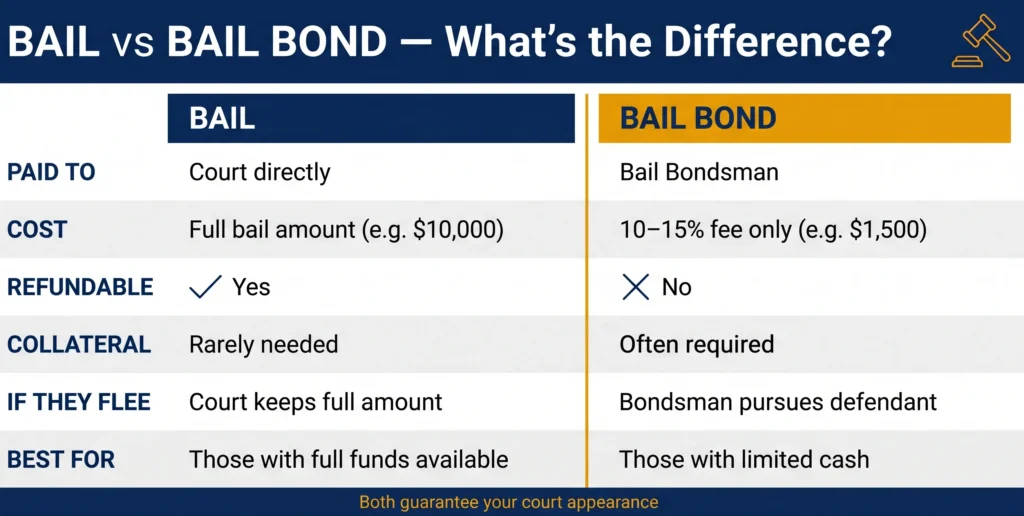
The core takeaway is straightforward: bail is a direct financial transaction with the court, while a bond is a licensed guarantee provided through a third-party bail bond agency.
What Is Bail? Explained
Bail is money or property paid directly to the court to secure a defendant’s release from county jail before the trial date. It is not a punishment. Rather, bail functions as a financial guarantee that the defendant will return for all scheduled court appearances.
The court returns bail money at the end of the case, minus standard administrative fees, provided the defendant appears at every hearing as ordered. This refundability is one of the most important distinctions in the difference between bail and bond. The Eighth Amendment to the US Constitution provides the legal foundation for bail, explicitly prohibiting judges from setting excessive bail amounts. A judge sets the bail amount at arraignment or first appearance, typically within 48 hours of arrest.
Factors That Determine Bail Amount
Judges weigh several factors when setting the bail amount during an arraignment or first appearance hearing:
- Severity of charges: Felony charges carry significantly higher bail amounts than misdemeanor charges
- Prior criminal record: A defendant with prior convictions is considered a greater flight risk and typically receives higher bail
- Flight risk assessment: Judges evaluate whether the defendant is likely to flee before the trial date
- Community ties: Stable employment, long-term residency, and close family connections in the area lower the perceived flight risk
- Threat to public safety: Defendants charged with violent offenses may face elevated bail or outright denial of pretrial release
Types of Bail Defined
Not all bail looks the same. The type of bail granted depends on the charges, the defendant’s history, and the judge’s assessment:
- Release on Own Recognizance (ROR): The defendant signs a written promise to appear in court; no money changes hands; this option is reserved for low-risk cases with strong community ties
- Cash bail: The defendant or family pays 100 percent of the bail amount in cash directly to the court
- Property bond: Real estate property is pledged as collateral instead of cash; this requires a formal appraisal and legal documentation before the court accepts it
- Unsecured bond: The defendant promises to pay the full bail amount only if they miss a scheduled court appearance; nothing is paid upfront
What Is a Bail Bond? Explained
A bond, most commonly called a bail bond, is a written surety bond agreement between the court, the defendant, and a state-licensed bail bond agency, guaranteeing the defendant will appear at every scheduled court date. Bonds exist for one primary reason: and that’s the nature of how bail bonds work? most defendants simply cannot afford to pay 100 percent of a court-set bail amount out of pocket.
A bail bondsman is a state-licensed professional who posts the full bail amount with the court in exchange for a non-refundable fee paid by the defendant or their family. Bail Bonds In California and most US states, this bail bond premium is set at 10 percent of the total bail amount, regulated by state law. Critically, the bond premium is never refundable, even if the charges are dropped, the case is dismissed, or the defendant is found not guilty.
The bondsman may also require collateral for bail, such as a vehicle, a home, or other valuables, to cover the remaining financial risk on large bail amounts. If the defendant skips court, the bondsman becomes liable for the full bail amount posted with the court and has the legal right to employ a bounty hunter to locate and return the defendant. The cosigner, also called an indemnitor, bears additional legal and financial liability in that scenario.
Types of Bonds Explained
Understanding the types of bail bonds gives families more options when navigating the system:
- Surety bond: The most common type; a bail bond company guarantees full payment to the court; the defendant or family pays the 10 to 15 percent non-refundable premium
- Cash bond: The defendant or family pays 100 percent of the bail amount directly to the court in cash; technically bail, but sometimes called a cash bond in legal filings
- Property bond: Real property is used as collateral for pretrial release; the court places a lien on the property equal to the bail amount
- Personal recognizance bond: The defendant is released on their signature alone, with no financial exchange required
- Federal bond: Used exclusively in federal criminal cases; typically carries more restrictive conditions and higher premiums than standard state bonds
- Immigration bond: Applies to ICE detainees held on immigration violations; requires a bail bondsman with specific federal authorization to process
Core Difference: Category Breakdown
For any family trying to act fast, this section is the most practical part of understanding the difference between bail and bond. Each category below captures a specific dimension where bail and bond diverge in ways that directly affect your wallet, your timeline, and your legal exposure.
Who Pays Defines the Difference
The question of who pays the court separates bail from bond in the most direct way possible:
- Bail: The defendant or their family writes a check or delivers cash directly to the court clerk; no third party is involved
- Bond: A licensed bail bond agent pays the full bail amount to the court; the defendant or family pays only the non-refundable 10 to 15 percent premium directly to the bondsman
Refundability Shapes the Difference
Money is at stake, and refundability is where that reality becomes clearest:
- Bail: The court returns the full bail amount at the conclusion of the case if the defendant attended all required court appearances; the court may deduct small administrative fees
- Bond premium: The money paid to a bail bond agency is never returned to the defendant or family under any circumstances, regardless of the case outcome, even if the case is dismissed on the first court date
Court Accountability Separates the Difference
The number of parties legally involved changes everything about accountability:
- Bail: Only two parties are involved, the court and the defendant; accountability is direct and simple
- Bond: Three parties are involved, the court, the defendant, and the bail bond company; each has distinct legal obligations under the surety bond agreement
- Missing court with bail: The court keeps the full bail amount and issues a bench warrant for the defendant’s arrest
- Missing court with bond: The bondsman loses the full bail amount posted; they may dispatch a bounty hunter; the cosigner or indemnitor faces additional financial and legal consequences
How the Bail Bond Process Works
Here is a step-by-step walkthrough of exactly what happens from arrest to release, so families know what to expect at every stage.
Arrest and booking:
Law enforcement arrests the defendant and transports them to county jail for booking, fingerprinting, and processing, a process that typically takes two to eight hours
Bail hearing at arraignment:
The defendant appears before a judge at their arraignment or first appearance, where the judge reviews the charges and sets the bail amount
Contact JR’s Bail Bonds:
The family or defendant calls Jr’s Bail Bonds, available 24 hours a day, seven days a week, to begin the bond process immediately.
Case review:
The bail bondsman reviews the bail amount, the nature of the charges, the defendant’s history, and other relevant details to assess risk
Premium payment:
The family pays the non-refundable 10 percent bail bond premium to the bondsman to initiate the process
Collateral evaluation:
The bondsman determines whether collateral for bail is required based on the bail amount and the defendant’s perceived flight risk
Paperwork and posting:
The bondsman files the necessary legal documents and posts the full bail amount with the court on behalf of the defendant
Defendant release:
The defendant is processed for release from county jail, typically within two to eight hours of the bond being posted
Court appearances:
The defendant attends every scheduled court date as required under the terms of the surety bond agreement
Bond exoneration:
Once the case concludes, the court issues bond exoneration, formally releasing the bondsman from liability, and any collateral held is returned to the family
How Much Does a Bail Bond Cost?
The bail bond premium is set at 10 to 15 percent of the total bail amount, and it is non-refundable regardless of how the case resolves. California state law caps the bail bond premium at 10 percent, which makes it one of the more consumer-protective states for defendants using a bondsman.
| Bail Amount Set by Court | Bond Premium at 10% | Bond Premium at 15% |
| $5,000 | $500 | $750 |
| $10,000 | $1,000 | $1,500 |
| $25,000 | $2,500 | $3,750 |
| $50,000 | $5,000 | $7,500 |
| $100,000 | $10,000 | $15,000 |
Collateral for bail may be required in high-risk cases or when the bail amount is substantial, giving the bondsman security against the possibility of bail forfeiture. Fortunately, JR’s Bail Bonds offers flexible payment plans for qualifying families who cannot cover the full premium upfront, because financial stress should not stand between a defendant and their pretrial release.
Pay Bail Directly vs. Use a Bond
The right choice depends on your financial situation, the bail amount, and how quickly you need the defendant released. Here is how to decide:
Choose to pay bail directly if:
- You have the full bail amount available in liquid cash without depleting emergency funds
- Bail is set at a low amount, typically under $2,000
- You want the money returned after the case concludes
- The case is expected to resolve quickly with only a few scheduled hearings
Choose a bail bond if:
- Bail is set at an amount your family cannot cover out of pocket
- You need the defendant released from county jail as quickly as possible
- Paying a 10 percent fee is more financially manageable than tying up the full bail amount for months
- You want a licensed bail bond agent to handle the paperwork and coordinate the release process
Your Legal Rights in This Process
The Eighth Amendment establishes that bail cannot be set at an excessive amount relative to the charges, and this constitutional protection applies in every US criminal court. Every defendant has the right to a formal bail hearing where they, or their criminal defense attorney, can challenge the bail amount and argue for a reduction. Legal representation matters enormously here, because defendants with a criminal defense attorney are statistically more likely to receive reduced bail or non-cash pretrial release options.
Bail can, however, be denied entirely in cases involving violent felonies or defendants the judge deems an extreme flight risk. Additionally, conditions of pretrial release, such as travel restrictions, regular check-in requirements, or electronic monitoring, can be attached to both bail and bond releases as a condition of the defendant remaining free before trial. Defendants should understand that violating those conditions can result in revocation of bail or bond and an immediate return to county jail.
Common Misconceptions About Bail and Bond
Several widely held beliefs cloud the real difference between bail and bond, and acting on misinformation can cost families thousands of dollars.
Misconception 1: Bail and bond mean the same thing.
They do not. Bail is a direct payment to the court; a bond is a licensed third-party guarantee. The financial obligations, parties involved, and legal consequences are entirely different.
Misconception 2: You always get bail money back.
Cash bail is refundable only if the defendant makes every required court appearance. Miss even one hearing without prior approval, and the court keeps the full bail amount.
Misconception 3: Bond fees are refundable if charges are dropped.
This is false. The bail bond premium is a service fee paid to the bondsman, not a deposit held by the court. Dropped charges have no bearing on the refundability of that fee.
Misconception 4: A bail bondsman can set or change the bail amount.
Only a judge has the authority to set, raise, or reduce bail at a bail hearing. The bondsman’s role begins after the judge sets the amount.
Misconception 5: You need an attorney to post bail or a bond.
No attorney is required to post bail or secure a bond. Families can contact a bail bond agency directly at any hour of the day.
Misconception 6: All bail bond companies charge the same rates.
While state law regulates the minimum premium rate, not all companies operate with the same transparency, speed, or flexibility on payment plans. Choosing the right bail bond agency matters.
Frequently Asked Questions Bail Vs Bond
No, bail and bond are not the same thing. Bail is money paid directly to the court by the defendant or family to secure pretrial release. A bond, on the other hand, is a licensed guarantee made by a bail bondsman on behalf of the defendant. The bondsman pays the court in full, and the family pays only a non-refundable premium, typically 10 percent of the total bail amount, to the bondsman.
If the defendant paid cash bail directly and charges are dropped, the court returns the bail money, minus any administrative fees. However, if a bail bond was used, the bond premium paid to the bondsman is never returned, not for dropped charges, case dismissal, or a not-guilty verdict. The premium is a non-refundable fee for the bondsman’s service, not a refundable court deposit.
Cash bail typically requires the defendant or family to gather the full bail amount before the court processes the release, which can delay things significantly for large bail amounts. A bail bond, by contrast, allows the bondsman to post immediately after the family pays the 10 percent premium. As a result, using a bondsman often results in faster pretrial release, typically within two to eight hours of the bond being posted.
Using a bail bondsman does not appear on a defendant’s criminal record. The bond is a financial transaction, not a criminal charge. However, the underlying arrest, the charges filed, and any resulting conviction do appear on the defendant’s criminal record. Families should not confuse the financial mechanics of bail and bond with the legal proceedings themselves.
Yes, but only a judge can modify the bail amount, not the bondsman. If a criminal defense attorney files a motion for bail reduction, a judge may lower the bail at a subsequent hearing. When that happens, the bondsman recalculates the premium based on the new, reduced amount. The bondsman has no power to negotiate with the court over the bail amount set at arraignment.
Common forms of collateral for bail include real estate equity, vehicles, jewelry, electronics, and other valuable assets. The bail bond agency holds the collateral as security against the possibility that the defendant skips a court appearance and triggers bail forfeiture. In lower-risk cases or when the bail amount is modest, some bondsmen may waive the collateral requirement entirely, relying on the premium payment and cosigner agreement alone.